
Get In On The Fun Of Team Cup Stacking: An Adaptable Game
by
Elizabeth O’Hara  Print This Article
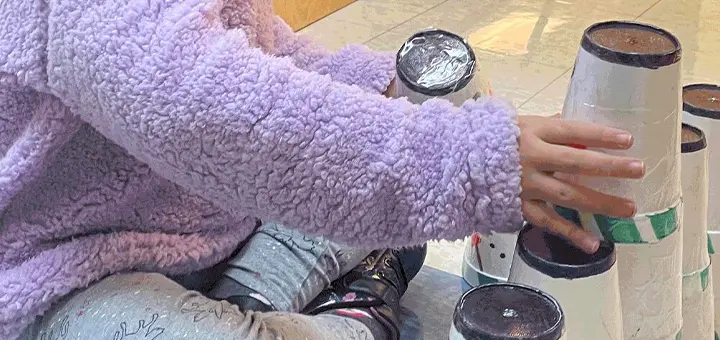
Cup-stacking may be an international phenomenon, but it is an adaptable game that allows children with special needs to participate with others.
Discover how to adapt team cup stacking for participants of various physical skill levels.

Who would have thought that cup stacking would become a world-wide sporting event?
It exploded in popularity throughout the country in 1990 after Matt Adame and his teammates were featured on The Tonight Show with Johnny Carson.
In the 1980s, Wayne Godinet, who worked at the local Boys & Girls Club, noticed that the children were tired of traditional sports.
He asked the children to stack paper cups as fast as they could. He substituted plastic cups for paper cups because it was easier to stack them.
Shortly thereafter, he formed his own company, Karago Cupstack Co., to manufacture and sell the cups along with the game instructions.
Today, cup stacking is a common activity in Physical Education classes all over the world due to Bob Fox, a physical education teacher in Colorado who was the first to introduce it to his students.
It is now included in the AUU Junior Olympics, and countries around the world have hosted competitions that have led to national teams.
The students in my classes enjoy the team cup stacking activity, which incorporates teamwork, agility, quickness, and fun.
Below, I describe the group game along with some creative modifications to meet individual and group needs, along with a video to demonstrate.
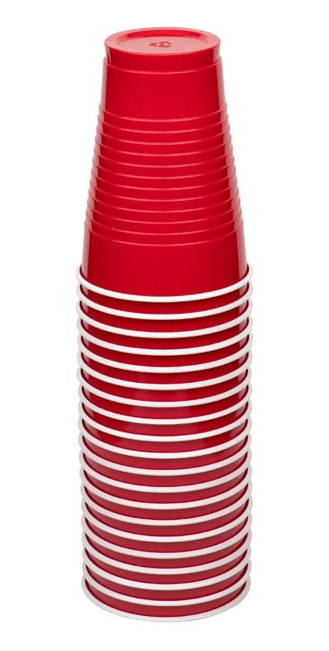
Supplies
- 25-50 short or tall plastic red cups
- A round flat plate
Directions
- Scatter all the cups randomly around the room.
- Place the round flat plate in the middle of the room to designate where the cups will be stacked.
- If you have a large number of students (10 or more) playing this game, divide them into two equal and smaller groups. If you have a small group, less than 10, keep them together in one group.
- With the cups scattered around the room, designate one person to maintain the time for each group to see how long it takes to stack all the cups, one on top of the other.
- The team that just stacked the cups must scatter them again for the next group.
- On the signal, time the other group to see if they can beat the first group’s time.
- The children may want to repeat this game to see if they can beat each other’s time.
- If less than 10 students participate, time them the first round and again to see if they could stack the cups in less time.
- This is a wonderful game for birthday parties or family or group outings.
Modifications
To improve one’s endurance:
- Scatter all the cups randomly around the room.
- On the signal or when the music is playing, the students jog between the cones. When the music stops, the players freeze.
- On the signal again the players leap/jump/run over the cups.
To improve teamwork and eye-hand coordination:
- Scatter 15 cups randomly around the room.
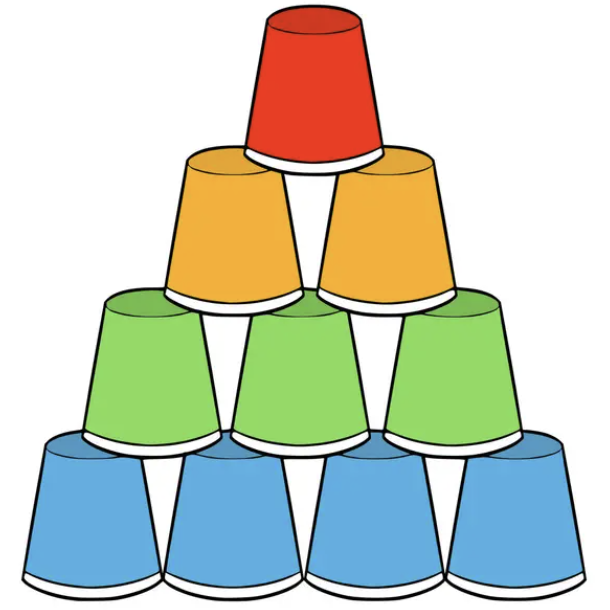
- On the command “GO,” one team at a time will each take one cup and stack the cups in the following manner – 5 cups on the bottom, 4 cups in the next row, 3 cups, two cups, and one on top as shown below (15 total). Document the time.
- Scatter the 15 cups around the room and allow the other group to stack the cups as fast as they can, documenting the time.
- Which team was able to perform the task in the least amount of time?
Adaptations
Using a mobility device
- Scatter all the cups randomly around the room and allow several cups to be placed on counters, tables, and chairs so that players using any type of mobility device can reach them.
- Make sure the area is clear and cones are placed far enough apart so that the players using mobility devices can maneuver around them.
- Place a stool in the middle of the room to stack the cups.
- Play the game as described above.
Not using a mobility device
- Individuals who can independently sit on the floor can stack the cups in the following manner.
- Scatter the 15 cups arm’s length from the player to the right and left sides and behind them.
- When the time starts, the player will grab the cups and stack them in the following manner – 5 cups on the bottom, 4 cups in the next row, 3 cups, 2 cups, and one on top (15 total). Refer to the picture above.
- Document the time.
- Repeat the process to see if they can beat their own time.
Have Fun!
Game Ideas
- 10 Board Games for a Great Special Needs Game Night
- A Round-Up of Educational Free Subscriptions, Storytime, Ebooks, And More
- Brain Games for the Season
- Infant Games Grows Brains
- Social Games in Shallow Water
- Got Pool Games?
- 7 Sensory Games Dads Can Play With Their Children
- What’s “APP”ening? Fun & Educational Game Apps for Children with Special Needs
This post originally appeared on our March/April 2025 Magazine