
Turning Summer Moments Into Skill Building Opportunities

How everyday summer activities can help children with special needs build independence, communicate on, social skills, and confidence
For many families of children with special needs, summer brings a change in routine, school schedules, and therapy intensity. While these changes can sometimes feel disruptive, summer can also be one of the best times of year to build important life skills.
From an Applied Behavior Analysis (ABA) perspective, summer provides natural opportunities to increase adaptive behaviors, maintain skills learned during the school year, and practice skills in real-life environments. Rather than viewing summer as a break from learning, families can view it as a season for practicing independence, social skills, communication, and safety in meaningful ways.
Summer Flexibility: Functional and Fun
During the school year, many children work on academic goals and structured therapy targets. Summer offers more flexibility to focus on adaptive behaviors, which are the daily living and functional skills that help children become more independent.
Adaptive skill areas that can be targeted during the summer include daily living skills, household responsibilities, social skills, community skills, and leisure and recreation skills. Families can also work on communication in natural environments, following routines and schedules, and flexibility and coping skills.
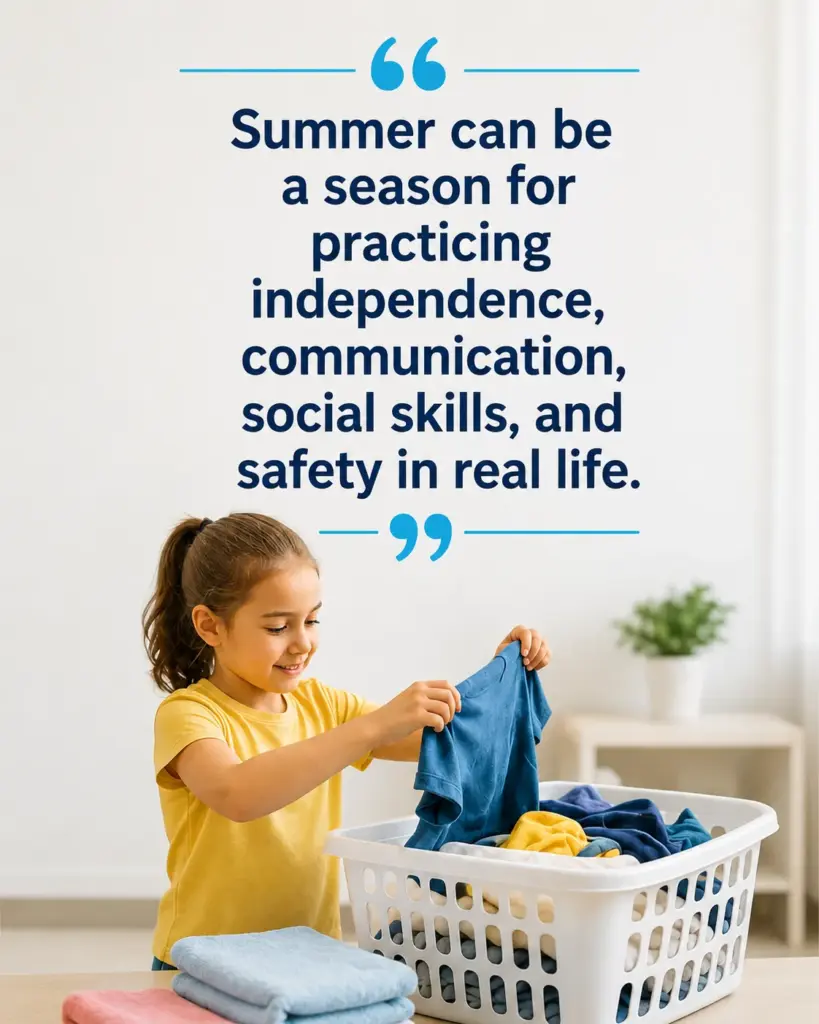
Summer routines often include trips to the store, vacations, parks, pools, restaurants, and family gatherings. All of these create natural opportunities to teach and reinforce skills in real-world settings. For example, cooking meals can teach following directions, measuring, and safety skills. Doing laundry can teach sorting, sequencing, and independence. Going to parks can teach turn-taking, social interaction, and safety rules.
These types of activities are often more meaningful than structured worksheets or table work because the skills are immediately useful and
functional in everyday life.
New Environments, Familiar Skills
One important goal during summer is maintaining and generalizing skills that were taught during the school year or therapy sessions. Maintenance means keeping skills from being lost, while generalization means using those skills in new environments and situations.
For example, if a child learned to request help at school, they can practice requesting help at home or at the park. If they followed a visual schedule at school, a summer schedule can be used at home. Generalization allows them to take familiar skills for a test drive in new circumstances.
Other generalization activities might include ordering food at a restaurant, asking a store employee for help, or playing with new peers at a park.
Generalization is one of the most important goals in ABA because skills are only truly meaningful if they can be used outside of therapy or school settings.
Maintenance activities might include reading for short periods each day, practicing math skills during cooking, or using communication systems such as AAC devices or picture communication. It can also include using visual schedules for routines, practicing writing by making grocery lists, and continuing behavior plans and reinforcement systems.
Adventures with a Purpose
Many common summer activities naturally support skill development, and parents can intentionally use these activities to practice communication, social skills, independence, and safety. Activities such as going to the pool provide opportunities to practice waiting, following rules, , and social interaction. Going to the park allows for practice with turn-taking and flexibility. Family vacations help children practice packing and following schedules.
Daily errands like grocery shopping provides opportunities to practice budgeting and following directions. Restaurants allow children to practice table manners and conversation skills. Camps provide opportunities for social skills and group instruction. Play dates help with sharing and cooperative play
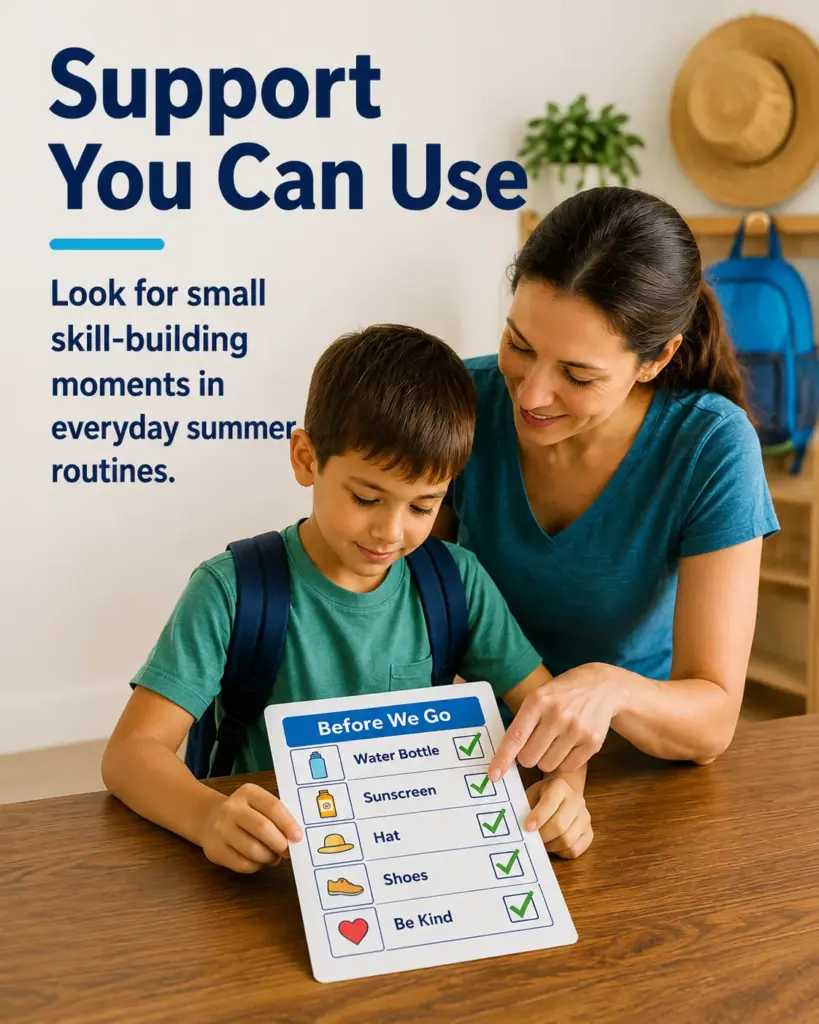
Parents do not need to create complicated lesson plans; simply identifying opportunities and reinforcing appropriate behavior can be very effective. Praising children for waiting appropriately, reinforcing social interaction, practicing asking for help, and practicing coping when plans change can all help build important skills.
Teamwork is Key
Summer is also an important time to communicate and collaborate with the child’s interdisciplinary team, which may include teachers, behavior analysts, speech therapists, occupational therapists, physical therapists, counselors, and physicians.
Collaboration helps ensure that progress continues over the summer and that goals remain consistent across environments.
Parents can support collaboration by sharing summer schedules and activities with the therapy team. It may also be beneficial to ask for home or community goals to work on, request behavior strategies for vacations or outings, and provide updates before the school year begins again.
Even if academic instruction is reduced during summer, many children make significant progress in adaptive and social skills through camps, programs, and daily activities.

Summer is for Safety
Safety skills are extremely important and should be intentionally practiced during summer months when children may be spending more time outdoors and in the community. Important safety measures include crossing roads safely, holding hands in parking lots, staying near caregivers, and understanding safe versus unsafe situations.
Water safety is critical and may include pool rules like asking before entering water, staying within designated areas, and wearing life jackets when appropriate. Teach children about the importance of responding to safety instructions such as “stop” or “come here.”
Elopement prevention may include practicing staying with caregivers in public places and responding when the child’s name is called. It can also include walking next to adults, identifying safe adults for help such as police officers or store employees, and using identification bracelets if necessary.
Social safety and personal space are also important and include understanding personal space, appropriate greetings, and not touching strangers. Families can also focus on using appropriate voice levels in public, waiting in line appropriately, and asking before touching items in stores.
These skills are often best taught through modeling, practice, role-play, and reinforcement.
When Fun and Learning Come Together
Summer can be a meaningful and productive time for children with special needs and their families. While routines may change, summer provides valuable opportunities to build independence, social skills, communication, and safety skills in natural environments.
From an ABA perspective, everyday activities such as grocery shopping, going to the park, family vacations, and community outings can become powerful learning opportunities.
Summer is an excellent time to focus on adaptive behavior, skill generalization, and the real-world application of skills learned during the school year. By maintaining communication with the interdisciplinary team, practicing safety skills, and intentionally using everyday activities as teaching opportunities, families can help ensure that their child continues to make progress throughout the summer months.
Most importantly, summer should also be a time for families to enjoy time together, build positive experiences, and create opportunities for children to learn through fun, meaningful, and engaging activities. When learning is embedded into enjoyable summer experiences, children are more likely to participate, practice new skills, and continue growing in independence and confidence.
Calm Summer Creativity
When summer feels long or overwhelming, sometimes a simple creative activity can help create a quiet moment of calm and independence.
That’s why we created EZY Trace Summer Moments — printable tracing pages designed to encourage creativity, confidence, and screen-free fun at your child’s own pace.
Preview EZY Trace Summer Moments
About Our Experts
Interim author Jenn Lenderman’s bio: Jennifer Lenderman is a Board Certified Behavior Analyst who has served families in the home and community setting since 2008. She strongly believes in parental empowerment and collaboration to improve the lives of those she serves.
Holly Downs, BCBA, LBA, is the Compliance Director at PBS Corp and an instructor at the Florida Institute of Technology. She has over 15 years of experience in ABA, and specializes in parent coaching, teaching, and delivering direct therapy for individuals with comorbidities. EZY Trace Summer Moments