
What does independence really look like for your child?
It might start with learning to make a bed or remembering to heat up leftovers. Helping your child build independence isn’t about perfection—it’s about progress. Whether it’s daily routines, new environments, or supportive tools, independence grows one skill at a time.
In this article, we explore real-world strategies, helpful products, and supportive communities that are making a difference. If you’re wondering where to start or how to keep going, you’re not alone—and we’re here to help.
Creating a Path to Independence: Tools and Communities Helping Individuals Thrive
For many families raising a child with a disability, the goal of independent living can feel both inspiring and daunting. But independence is not about doing everything alone—it’s about having the right supports in place.
Whether it’s learning to manage daily routines, navigating shared living spaces, or building a sense of personal pride, families are finding meaningful ways to help their loved ones grow. In this article, we explore practical approaches and real-life tools that are helping individuals achieve greater independence.
From innovative bedding systems to smart technology and intentional communities, these solutions are proving that with the right support, independence is possible.
Starting Small: Confidence Through Daily Tasks
One of the most common questions we hear from parents is: How can I help my child feel more capable at home? Often, it starts with small daily victories.
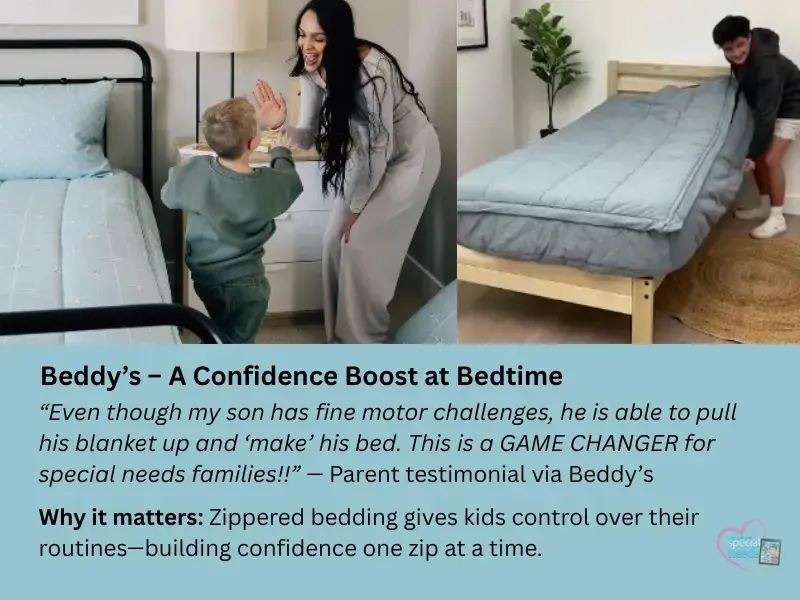
Making the bed may seem simple, but for children with fine motor challenges or sensory sensitivities, it can be a daunting task.
In PSN’s feature “Important Life Skills to Teach Your Child with Special Needs,” [1] we highlighted how building routines with tangible success fosters confidence and self-determination.
 [2]
[2]
“I just wanted to say we just ordered a Beddy’s for my daughter who has multiple health issues and autism and this blanket she says is the best! The softest and most comfortable. She slept the best she has slept in a long time because she struggles with sensory issues and this bedding will help her and us so much. I have even debated about getting my son one as he has autism… I think it works better than a weighted blanket!” —Brittany Watson
Zippered bedding from Beddy’s allows children to make their beds with ease, giving them a tangible sense of independence and ownership of their space. For many families, it’s more than bedding—it’s a confidence boost that starts the day off right.
Assistive Technology That Supports Growth
As children grow into young adults, new challenges emerge: How do I know they’re safe when I’m not there? What supports can help them live more independently? In recent years, families have increasingly looked to technology for answers.
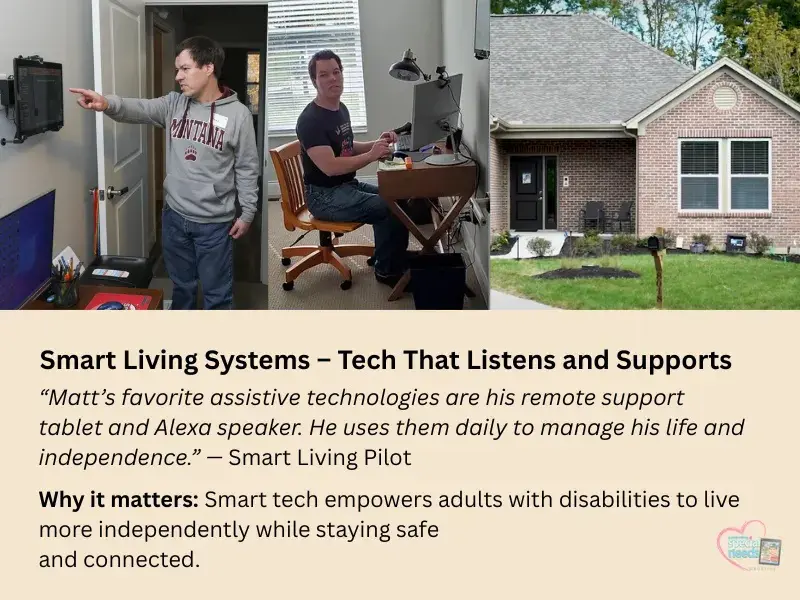
In LADD’s Smart Living Pilot, powered by Smart Living Systems, Matt was eager to expand his independence. He moved from an apartment adjacent to several group homes to a community-based home with three housemates. It was his dream to move back to the township where he grew up and thrive in his former stomping grounds. While Matt joined the Smart Living Pilot with experience living in an apartment, he always had staff within reach if needed.
 [3]
[3]
Over the course of a three-year pilot, Matt has been successful in using tech-enabled supports to increase his independence, as measured by Xavier University’s Department of Occupational Therapy. His favorite assistive technologies are his remote support tablet and Alexa speaker.
Smart Living Systems is primarily licensed to a provider agency, which delivers remote support through its integrated platform. This license can also be provided to individual families. Hardware and software costs may be covered by a waiver, and private pay options allow families to work directly with the provider to determine the best solutions.
Working alongside a Xavier University occupational therapy graduate, Smart Living Systems developed a comprehensive assessment that evaluates an individual’s needs across all life domains. Based on this assessment and input from the person and their care team, they configure personalized technology plans that include remote and natural supports. Technology can be tailored to the individual or shared within a group home. Even in a shared space, each person can maintain their own custom solutions, reflecting both shared and individual needs.
Skill-Building at Home, Before the Move
Independence doesn’t begin when your child moves out—it begins at home. Long before a lease is signed or a roommate is chosen, the path to independent living is built on small, intentional teaching moments. As we shared in our PSN article “Preparing for the First Apartment: Beyond Home Furnishings,” parents often focus on what to pack—not what to practice. But skills like handling leftovers, making a repair call, or staying alone for a few hours are often the true tests of independence.
- How to manage leftovers safely, not just how to use a microwave
- How to clean the lint trap after doing laundry
- How to call a landlord when something breaks
- How to handle a quiet evening alone
📌 Try this: Encourage your child to “run” one aspect of the home for a week—like packing their own lunches, planning dinner one night, or doing laundry start to finish. Skills practiced at home now will build confidence later.
Supportive Living Communities for Adults with Disabilities
Of course, not every family has the same roadmap. Some children may thrive in structured communities designed to support their needs long-term. So how do we find the right balance between support and autonomy?
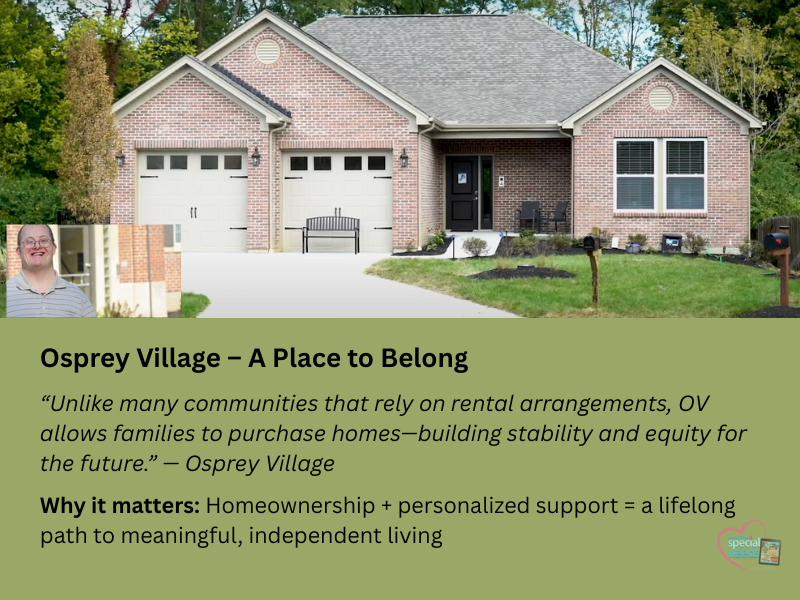
Osprey Village (OV) offers a unique model for independent/supported living for adults with IDD. It is all about community, connection, and celebrating each resident’s unique journey to independence.
Unlike many communities that rely on rental arrangements, OV allows families to purchase homes, allowing residents and their families to build equity and invest in their futures. This innovative for-purchase model creates long-term stability, financial security, and a true sense of ownership and belonging.
Beyond housing, OV stands out for its deep commitment to personalized support, community integration, and lifelong growth. Through person-centered assessments, tailored support plans, and a vibrant community culture, OV empowers adults with IDD to live independently with the right level of support.
 [4]
[4]
Support at OV is flexible, personalized, and empowering. Residents can access help with daily living skills, health and wellness, community navigation, and goal-setting in a way that respects their choices. Some residents may need support with cooking, shopping, or managing schedules. Others simply need occasional check-ins or encouragement. Training is also provided in areas like human rights, social skills, and maintaining healthy boundaries.
Technology is woven into daily life at OV to support safety, independence, and connection. Devices like smart home systems, medication dispensers, emergency response tools, and communication tech help residents manage daily tasks and stay connected. To further enhance support, OV is looking to partner with Simply Home to provide a range of assistive technology beyond standard home devices.
What It All Means for Families
In our work with families, educators, and self-advocates, one truth remains clear: independence doesn’t happen overnight. It’s a journey, shaped by trial, trust, and tools that support each individual’s growth. Whether it’s a made bed, a smart speaker, or a forever home, every step matters. These stories show us what’s possible when we celebrate ability, teach daily skills, and create environments where independence is nurtured—not rushed.

Helpful Articles
- Puberty and Hygiene: How to Support Our Children [5]
- Important Life Skills to Teach Your Child with Special Needs [1]
- Puberty Help! Great Books to Help You with Questions and Challenges [6]
- Embracing Your Child’s Best Ways of Learning 12 Different Ways to Learn [7]
- A Complete Guide on Dental Care for Children with Special Needs [8]
- Spa Day [9]
- Starting Your Day off Right: Making the Most of Morning Routines [10]
- The Importance of Teaching Children Body Safety [11]
- Learning Life Skills: Tech Can Play a Role [12]
You May Also Like
- Preparing for the First Apartment: Beyond Home Furnishings and Domestic Supplies [13]
- What Are Pre-Employment Skills and How Does My Child Get Them? [14]
- Where to Go if Your Child Needs a Job or Help with Post High School Education [15]
- Best Gluten Free/Casein Free Products and Where to Find Them [16]
- Financial Planning: For Those Who Are at the Starting Line [17]
- Help Your Child Develop Self-Discipline For Life Success [18]
- Baby Steps Tips for Encouraging Your Child Toward Independence [19]
- Making Learning Fun: Teaching Pivotal Skills [20]
This post originally appeared on our May/June 2025 Magazine [21]