
When the System Is Strained, the Law Still Stands
Across the country, families are hearing the same message:
There are not enough intervention specialists. Special education positions are unfilled. Services may be delayed.
While those challenges are real, they can quietly shift something that should never move: expectations.
When systems are stretched, families are often asked — directly or indirectly — to accept less.
- Less service.
- Less clarity.
- Less accountability.
This is where understanding your child’s rights — and how to use them
— becomes critical.
This is where guidance from Wrightslaw becomes essential.
Wrightslaw is a nationally trusted resource that teaches parents, educators, and advocates how to understand and use special education law to protect the rights of children with disabilities.
The Difficult Reality
There is no question that schools are under pressure.
Per the National Association of School Psychologists, school psychologist ratios average 1,071:1 — more than double the
recommended 500:1.
ASHA, the American Speech-Language-Hearing Association, reports that school districts consistently struggle to fill SLP positions, with some vacancies remaining open for months or even the entire school year.
Rural districts often face the greatest barriers to accessing specialists.
These shortages are not abstract.
They can lead to:
- delayed evaluations
- missed or reduced services
- gaps in communication
When positions go unfilled, services can quietly slip — not because the law changed, but because systems are stretched.
And when that happens, the risk shifts to the child unless the parent steps in.
According to Wrightslaw, schools cannot use staffing shortages as a legal excuse for failing to provide services in a child’s IEP.
Under IDEA, the district is still responsible — even if they cannot find an SLP, OT, PT, counselor, or behavior specialist.
Family Frustration
A parent is told:
“We don’t currently have a speech therapist, so services may be delayed.”
Without a clear response, that delay can continue indefinitely.
But with better knowledge and stronger questions, the conversation shifts to deliverables:
- How will services be delivered in the meantime?
- What is the timeline to resolve this?
- How will missed services be made up?
This is the difference between waiting — and advocating.
At Parenting Special Needs, we hear from families every day who are navigating these exact challenges.
Parents tell us:
- “I didn’t know I could push back.”
- “I thought the school would handle it.”
- “I didn’t realize I needed to ask for agreements in writing.”
This is where the disconnect often happens.
Not because parents do not care — but because the process is not clearly explained.
A Real-Life Example
One parent shared:
“The teacher kept suggesting that my son might need extra help, or an evaluation. I thought that was something she was going to take care of. I didn’t realize that I had to actually write an email to the school and ask that my son be evaluated for special education services.”
— Leigh G., Son in 1st Grade
This moment is more common than families realize.
Schools may raise concerns — but the formal process often begins with a written request.
In special education, written words trigger action.
What Has Not Changed
Parents must anchor themselves in one unchanging reality:
Their child’s rights are grounded in the Individuals with Disabilities Education Act (IDEA), and those rights do not disappear because of administrative changes or staffing shortages.
Under IDEA:
- Parents are equal members of the IEP team
- Children are entitled to a Free Appropriate Public Education (FAPE)
- Schools must ensure meaningful participation
- Schools must provide prior written notice when proposing or refusing
changes - Parents have the right to request an Independent Educational
Evaluation (IEE)
This is not flexible guidance.
It is enforceable law.
“Rights are only as strong as their enforcement.” — Wrightslaw
The Parent Shift That Matters Most
In a fully staffed system, schools manage more of the process.
In a strained system, parents must manage more of the clarity.
That means:
- writing everything down
- asking for data
- following up consistently
- approaching advocacy with greater precision
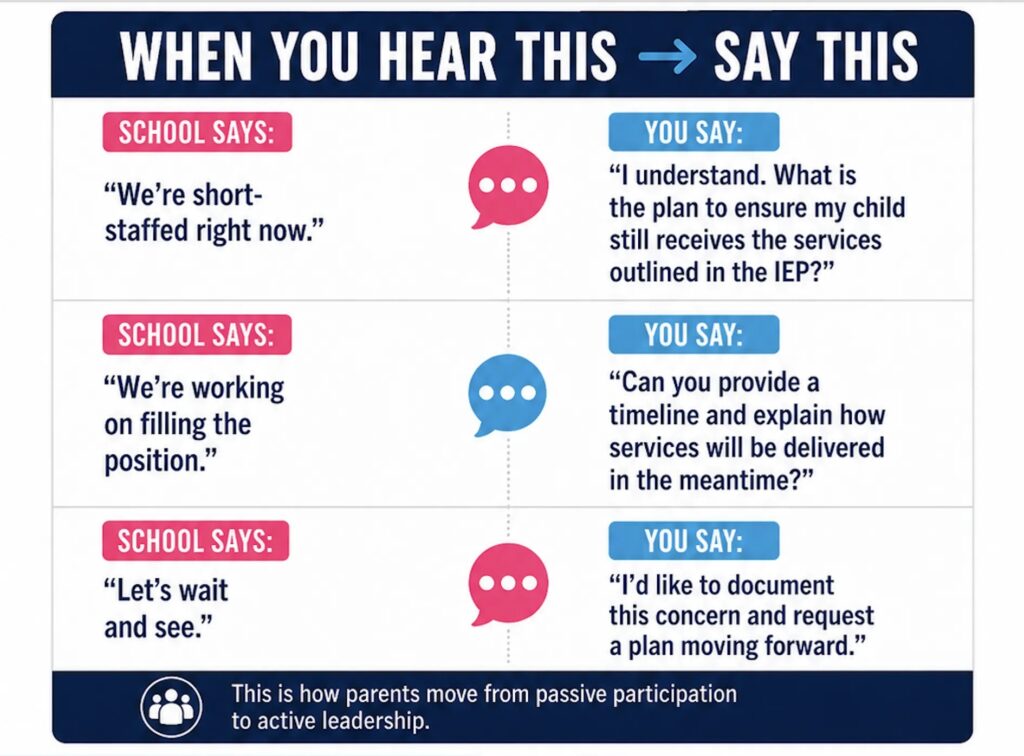
When You Hear This → Say This
School says:
“We’re short-staffed right now.”
Parent response:
“I understand. What is the plan to ensure my child still receives the services outlined in the IEP?”
School says:
“We’re working on filling the position.”
Parent response:
“Can you provide a timeline and explain how services will be delivered
in the meantime?”
School says:
“Let’s wait and see.”
Parent response:
“I’d like to document this concern and request a plan moving forward.”
This is how parents move from passive participation to active
leadership.
When Services Are Reduced or Not Delivered
Wrightslaw is clear:
Action must be immediate and documented.
Step One: Put It in Writing Immediately
Write a clear, concise letter or email stating:
- What services are missing or reduced
- How does this differ from the IEP
- How is it affecting your child
Request an explanation and corrective action.
Because according to Wrightslaw:
“If it is not in writing, it does not exist.”

Step Two: Request Data and an IEP Meeting
Request:
- service delivery logs
- progress data
- implementation reports
Then schedule an IEP meeting.
At that meeting, require the team to explain — using data:
- Why were services changed or not implemented
- What corrective action will be taken
If the school proposes a change, it must comply with prior written
notice.
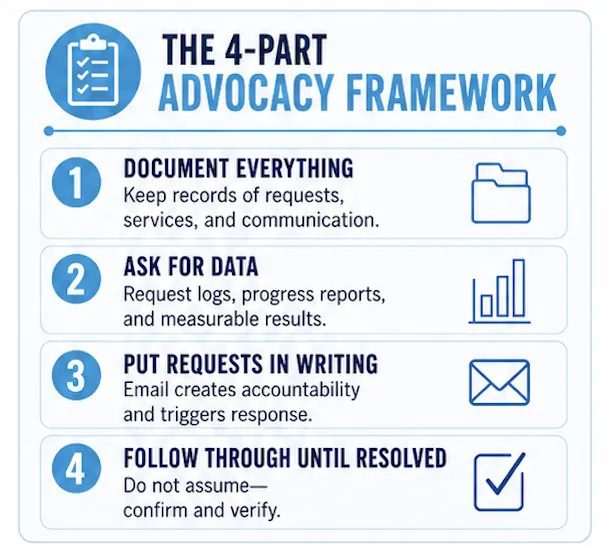
The 4-Part Advocacy Framework
To stay grounded and effective:
- Document Everything
- Ask for Data
- Put Requests in Writing
- Follow Through Until Resolved
This is how rights move from paper to practice.
The Most Common Mistakes in IEP Meetings
Wrightslaw identifies patterns that weaken advocacy:
- using the word “best” instead of understanding the legal standard of appropriate (FAPE)
- focusing on placement before developing the IEP
- attending meetings without preparation
- failing to follow up in writing
- allowing emotions to override strategy
Effective advocacy requires preparation, clarity, and persistence — not just participation.
One Action That Changes Everything
Write a Parent Concerns Letter this week.
Briefly describe:
- What is working
- What is not
- What should change
Send it by email and request that it be included in the IEP record.
This single action:
- creates an official record
- triggers required responses
- preserves your rights
See Wrightslaw.org for examples:
Letter to the Stranger [1]
Sample Letter [2]

The Bottom Line for Families
The system may be strained.
But the law has not shifted.
Parents must not lower expectations because the system is struggling.
They must increase:
- clarity
- documentation
- follow-through
In times like this, an informed, organized, and persistent parent is the strongest protection a child has.
There is a lot that may feel uncertain right now.
But your role is not uncertain.
You are not just attending meetings.
You are not just signing paperwork.
You are enforcing a law written to protect your child.
And that is where real change begins.
A Final Word of Encouragement
As Karen Mayer-Cunningham reminds us:
“IDEA, the Individuals with Disabilities Education Act, is the only federal law implemented by parents. The reality is that the school staff members may or may not know your rights. Get a copy of your procedural rights and safeguards, and study it thoroughly. These protections may only come to you if you educate yourself about them and invoke them.”
“There is a child who needs you to stand up for them, to speak for them, to expect their IEP to be implemented in accordance with the agreed-upon plan. You can do this; we stand with you. An implemented IEP may give a family hope and a child a future.”
Special Thanks
Parenting Special Needs extends special thanks to Pete Wright and Pam Wright, founders of Wrightslaw [3], for their continued advocacy, educational leadership, and contribution to this article supporting families navigating special education services and IEP rights.
We also thank Karen Mayer-Cunningham [4] for sharing encouragement and perspective with the Parenting Special Needs community.