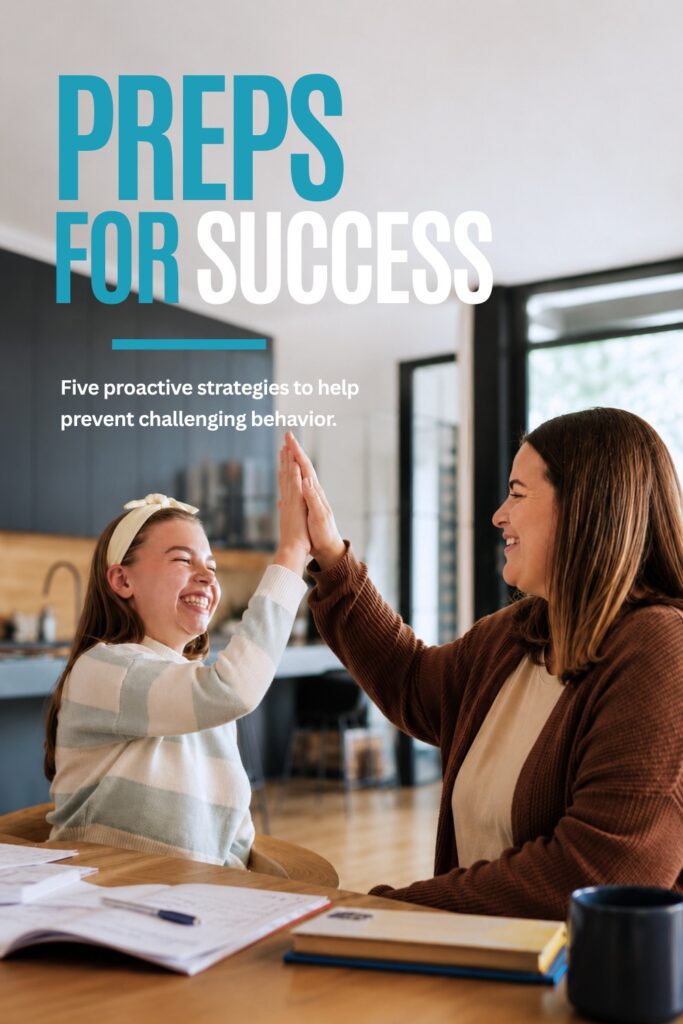
Many challenging behaviors begin long before a meltdown or refusal occurs. These five proactive strategies can help reduce stress, build cooperation, and create more successful everyday experiences for children and their families.
By increasing Predictability, getting children Ready for transitions, Empowering them with choices, building Positive momentum, and Simplifying difficult tasks, you can often prevent challenging situations before they begin – and help your child feel more successful, confident, and supported along the way.
Eight-year-old Sam loved going places with his family – until it was time to get in the car.
As soon as his parents announced an outing, Sam’s anxiety would begin to rise. He worried about where they were going, how long they would be gone, and what route they would take. Sometimes he cried. Sometimes he refused to get into the car. Other times he became so upset that family outings felt nearly impossible.
Like many children with autism and other developmental disabilities, Sam wasn’t trying to be difficult. He was overwhelmed.
Many parents of children with autism and other special needs know this feeling. Challenging behaviors such as meltdowns, aggression, refusal, and emotional outbursts often seem to appear suddenly, but they are frequently triggered by predictable situations: difficult tasks, transitions, uncertainty, sensory discomfort, and feeling out of control. While parents often focus on what to do after challenging behavior starts, one of the most powerful approaches is preventing it from happening in the first place.
The good news is that there are often proactive strategies we can use before challenging behavior starts.
One easy way to remember these proactive strategies is the acronym PREPS:
At a Glance: Remember PREPS
P – Predictability through visual cues
R – Ready for transitions with reminders, timers, and countdowns
E – Empower with choices
P – Positive momentum before difficult tasks
S – Simplify tasks and build on strengths
P: Predictability Through Visual Cues
Many children feel calmer when they know what is happening next. Visual cues or supports reduce uncertainty and help children prepare for upcoming events.
Visual supports might include:
- Picture schedules
- Written schedules
- Charts showing First-Then
- Checklists
- Social Stories
For Sam, one major source of anxiety was not knowing where the car was going. To make outings more predictable, his parents created a simple visual schedule showing the locations they would visit that day. Before getting in the car, Sam reviewed the schedule with his parents.
Because he could see what was coming, he became calmer and more willing to participate.

HOW TO USE IT:
Step 1: Identify a situation that is difficult for your child.
Step 2: Create a simple visual schedule using pictures, words, or both.
Step 3: Review the schedule before the activity begins.
Step 4: Refer back to the schedule throughout the activity.
R: Ready for Transitions with Timers and Countdowns
Transitions are one of the most common triggers for challenging behavior. Children often become upset when a preferred activity ends or a new activity begins unexpectedly.
Imagine being deeply involved in something you enjoy and suddenly hearing, “Time’s up! We’re leaving now!” Many children experience transitions exactly that way.
Timers and countdowns give children time to prepare for upcoming changes.
For Sam, getting out of the car at a destination was often difficult because the transition felt sudden. Instead of saying, “We’re here – let’s go,” his parents began providing warnings:
- “Five more minutes.”
- “Two more minutes.”
- “One more minute.”
Gradually, Sam became more successful because he had time to adjust to the upcoming change.
HOW TO USE IT:
Step 1: Give an early warning (e.g., “Ten minutes until we leave the playground.”)
Step 2: Provide additional reminders as the transition approaches. (e.g., “Five minutes left. Two minutes left. One minute left. 10-9-8-7-6-5-4-3-2-1… time to go!”)
Step 3: Use a visual timer whenever possible.
Step 4: Follow through consistently when the time is up (when the timer ends, calmly move to the next activity).
E: Empower with Choices
Everyone likes having some control over their day. Children are no different.
Many (if not most) children spend much of their day being told where to go, what to do, and when to do it, with very little choice or control.
Offering choices empowers children by increasing their sense of control, which can reduce power struggles and increase cooperation because children feel like active participants rather than passive passengers.
For Sam, car rides became easier when his parents gave him choices. Before leaving, he could choose which books, toys, or comfort items to place in his “car bag.” Whenever possible, he could also help choose the destination.
These small choices helped him feel more in control and less anxious.

HOW TO USE IT:
Offer choices between 2-3 options (e.g., “Do you want the blue marker or the green marker?”). Open-ended questions may overwhelm a child who is already feeling uneasy.
Choices may include:
- Which task to do first
- Which materials to use
- Where to sit while working
- Which clothes to wear
- Which coping tool to bring on an outing
P: Positive Momentum Before Difficult Tasks
Some tasks are harder than others. Before asking a child to do something challenging, like doing homework or brushing teeth, it can help to build momentum by starting with easy successes.
Think of it like pushing a bicycle. Once it starts moving, it’s easier to keep it moving.
For example, ten-year-old Jacob frequently argued when it was time to start homework. Instead of immediately saying, “Go do your homework,” his mother began with a few easy requests:
- “Give me a high five.”
- “Can you hand me that pencil?”
- “Can you show me your science folder?”
After Jacob successfully completed several easy tasks, she followed with:
- “Great. Let’s start the first homework problem.”
Because Jacob was already engaged and cooperating, homework battles became less frequent.
HOW TO USE IT:
Before a difficult task:
Step 1: Give two or three easy requests your child usually completes successfully (e.g., “Give me a high five,” “Touch your head,” “Show me your favorite toy”).
Step 2: Give praise for completing the easy task. (e.g., “Thank you! You did an awesome job with that!”)
Step 3: Immediately present the more difficult request (e.g., “Now let’s put your shoes on.”)
S: Simplify Tasks and Build on Strengths/Interests
Sometimes challenging behavior is a sign that a task feels overwhelming.
Challenging behavior is a form of communication. A child may be telling us, “This is too hard,” “This takes too long,” or “I don’t know how to do this,” for example.
When that happens, ask yourself: Does my child need the task to be easier, shorter, or more motivating?
For example, twelve-year-old Maya became upset whenever she was asked to clean her room. Her parents realized that “Clean your room” actually involved many separate tasks. Instead of expecting her to complete everything at once, they broke the task into smaller steps:
- “Put the books on the shelf.”
- “Put the dirty clothes in the hamper.”
- “Put the stuffed animals on the bed.”
Because Maya experienced success with each small step, she was more willing to continue.
You can also increase motivation to complete a difficult or disliked task or activity by incorporating your child’s interests. A child who loves trains may be more willing to practice counting using train pictures. A child who loves animals may enjoy reading books about their favorite animals.
For example, Maya’s parents also incorporated her love of animals by using animal-themed storage bins and labels. This made the task less overwhelming and more motivating. They also reminded Maya that her animals would not want to live in a messy space.
When tasks feel achievable and meaningful, children are often more willing to participate.
HOW TO USE IT:
Ask yourself:
- Can I break this task into smaller, easier steps?
- Can I shorten it?
- Can I provide more help?
- Can I incorporate my child’s interests?
Putting PREPS into Practice
No strategy works every time or for every child. The key is to think proactively rather than reactively.
When you notice challenging behavior increasing, ask yourself:
- Is my child unsure about what is happening next?
- Have I prepared them for the transition?
- Have I offered choices?
- Can I build momentum before this task?
- Does the task need to be simplified?
Using proactive strategies won’t eliminate every difficult moment, but it can reduce many of the situations that trigger challenging behavior in the first place.
The Big Picture:
It is important to note that, while PREPS helps reduce the likelihood of challenging behaviors, it does not prevent them entirely. Children will still experience unexpected situations, strong emotions, and unmet needs that affect how they behave and communicate.
When challenging behaviors do occur, the focus shifts from preventing to responding and, once the child is calm, teaching them replacement skills that help them get their needs met in a better way. Children need opportunities to learn new skills, practice more effective ways of communicating their needs, and receive supportive responses from the adults around them. PREPS remains the foundation. By proactively creating supportive environments, teaching expectations, and building skills before challenges arise, you give your child the best opportunity for success.
This article is featured in our current digital issue. Explore the full issue here. [1]