A Dream Beginning—and a Life-Changing Diagnosis
The minute I heard that my newborn daughter had a one in 10 chance of surviving her viral myocarditis, I knew my life had changed forever. The first weeks in the hospital revealed brain damage, heart issues, and hearing loss, among other problems. The experience created a searing heat that can tear your family apart or fuse it together.
Three years before Kathryn, her sister, Alana, had started us on the road to parenthood in the dreamiest way. With her, I thought I’d entered Heavenly Daddy School. Those years were filled with deliriously wonderful play, exploration, and discovery. My wife, Linda, and I raced giggling to see who could respond first to Alana‘s every murmur.
The birth of Kathryn and her hospitalization pushed Alana from reigning princess to occasionally abandoned, and second priority. That’s one of the gut-wrenching tradeoffs of parents with disabilities among siblings. Often, when Kathryn was in intensive care, either mom or dad had to bolt to the hospital to respond to doctor’s findings or give consent for treatments.
Holding Up the Sky
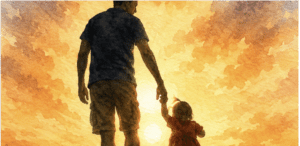
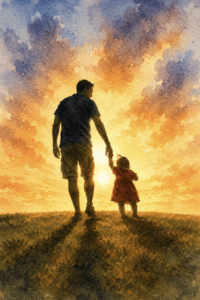
One night, after weeks in intensive care, Kathryn survived her third heart failure the very hour that my father died. The next night, Linda and I gathered with Alana to break the awful news. Alana was already struggling to escape the dreadful reality of her infant sister battling for her life. At the moment I met Alana’s eyes in her bedroom, I felt a tidal wave of dark, rolling clouds about to break over me. I pictured myself holding my arms high into the air, to hold up the sky, to keep it from crashing down on us.
But Kathryn survived.
When Home Became a Hospital
Over the next two years, our home barely resembled the warm, colorful place we had created for the girls. The house was as much a clinic as home. Medicines were administered 24/7. Anxiety vibrated through the house. We walked on eggs, afraid that Kathryn might catch something, even a cold could be fatal. We struggled to keep Alana protected from bad news about her sister and from her parents’ depression.
Gradually, Kathryn recovered. With delays in muscle development, she was a floppy doll for 18 months. “This condition is normal,” the physical therapist said. “With time, she will recover her muscle tone.“
The fact that Kathryn could chew her food, but not swallow, made it hard to be confident about the physical therapist prediction. After her third year, Kathryn began to pick up strength. A shine in her eyes brightened. She began to utter basic words. We dared to think about some kind of normalcy.
A New Hope, A New Challenge
We thought of resuscitating our experience of parenthood by having a third child. After all, Kathryn’s virus was just dumb, bad luck. No one knew where it came from in northern California that year.
Nine months later, Eric was born. We called him Mr. wonderful for the first year. He was so much easier than his sister had been. That’s why the shock was overwhelming when we learned that Eric had developed a hearing deficit—out of the blue, no family history—worse than her sister’s.
The new family was battered but not broken. We found ourselves with three children, all of them bright lights in their own way, but two of them with disability challenges. For Kathryn, it was comprehension issues, short-term memory problems, and developmental delays. For Eric, the issue was not just hearing deficit, but also difficulties in auditory processing. But Eric also had the natural intelligence of his oldest sister, Alana. He looked up to her. Three children—two gifted, two with disabilities (Eric had both)—created a complicated dynamic.
Learning to Be the Father My Children Needed
Often, I felt lost in the wilderness of fatherhood. The turbulence and mismatches in the family threatened my vow to be distinct from my own father’s brash, rough exterior and emotional absence. I had dreamed of being the guy who could light up the darkness in my children’s hours with the light of my eyes. Some mornings, I didn’t want to open my eyes. My dream was now threatened. With the sometimes-chaotic family routine, coupled with my inexperience and stress, could I keep my vow to be a different kind of dad?
Because Linda was engaged in a research project at a major hospital, I became a home dad for several years. I focused on listening intently to the children’s needs. I learned to express myself more clearly because of their hearing issues. I jettisoned internal images of myself becoming the main breadwinner, the chest-first guy who could march through any storm, my status as a doctoral student. None of these mattered for the kind of father I needed to be.
Building Trust Through the Storm
In addition to listening intently, I began to learn about the importance of trust. I understood that the children relied heavily on me to sort out the crosscurrents of emotions and fears that each of the children had about their siblings. I encouraged them to share their fears and anger, and in turn, I shared my own with them. But I did not lose sight of the need for dad to be strong and unwavering. At the same time, I thought it was important to be honest and open.
The oldest, Alana, could not avoid the inevitable survivor’s guilt and the oncoming stigma she would feel from her schoolmates about having siblings with challenges. Kathryn was often lost in a fog, unable to comprehend the whirl of life that surrounded her, unable to slow down the world to a pace that she could make sense of, and unable to fully communicate her needs to us and to her siblings. She used Eric as her crutch, even as he was desperate to have independence from her. He looked to his older sister as a model for himself. But Kathryn constantly pestered him with questions about the plan for the day, the time we were to leave, the time where to arrive. Finally, one day, he shouted, loudly: “Stop using my brain.”
I often had trouble drawing, and holding, a line. My kids’ disabilities—difficulty hearing, comprehending, having to contend with their different siblings—ate at me. Sometimes, I felt I had to soften the reality for one or another of the kids. My greatest weakness was my father’s strength. No do-overs. There’s a limit.
A Fresh Start and a New Chapter
After finishing my doctorate, it was my time to be the main breadwinner. I accepted the job that offered the best health benefits. We had piled up a giant tower of medical expenses. We moved across country to start a new life in Washington DC.
In many ways, the move to Washington was a symbolic new start for the whole family. We dedicated efforts to create and spruce up the kids’ new living spaces. The kids got fresh starts at three different schools, each uniquely suited to the children’s strengths. Plus, that financial stress had begun to ease.
The pattern of family dynamics settled in place over the next decade. This is not to say there were no clashes or discordance. There were. But the kids gradually adjusted to each other and assumed the ability to hold up their own sky. The principles of engendering trust, of listening intently, and staying humble helped to maintain a workable balance. In addition, each of the kids had the help and support of their respective friendship groups.
What Fatherhood Taught Me
Having been a father who tried too hard sometimes to hold up the sky, I learned several lessons that other fathers might find useful.
First, when you become a parent, you walk into the unknown. And if you want to change the template of fatherhood that you receive from your own father, you must remember that you’ll create a new puzzle for your own children, a puzzle which they will have to correct for their own reality. Each generation must decide to maintain or break the chain of fatherly heritage.
Second, I came to appreciate that the children are becoming something new every minute of the day. That’s the wonder of life and of being a parent. It brings the need for steady attention and patience, understanding that you must keep the long view.
Third, for me personally, the most bedeviling issue of raising children with disabilities is never knowing where to draw the line. The line of tolerance, that standard of behavior, is always blurry because of the disabilities. Softies like me are tempted to move the line a little to make a accommodation. But that can create problems later when a sibling may feel slighted or that you find you can’t hold the line once you’ve given in.
Fourth, building trust proved to be the strongest glue that kept me close to the kids, and this in turn, strengthened family coherence. Each moment I was honest with the kids, open to them and about myself, represented a new brick of trust being laid down for the future.
Finally, I learned to parse distinctions about masculinity and fatherhood. I discovered sharing your feelings is not weakness, but strength. It shows the kids that even when you feel threatened or angry or afraid, you can still soldier on, being a strong dad. I think my being open with the kids helped them to identify with me, allowed them to see themselves in me, and trust me more as a person and trust me as a father.
Our family buckled but did not break in the heat of misfortune. This year, I walk into another Father’s Day with gratitude to my adult kids, and to Linda, my wife of fifty years.
About the Author
This article is adapted from Tim E.J. Campbell’s memoir, Holding Up the Sky: Intergenerational Lessons of Fatherhood, available online and at bookstores