Summer can be challenging when schedules and care change considerably. Get helpful tips from other parents on navigating and enjoying a less stressful summer.
How Parents of Children with Disabilities Can Create a More Peaceful Summer
While most people are excitedly counting down to the start of summer, quite a few caregivers are looking ahead with dread.
Sure, longer days and warm evenings can be pure bliss. But when school lets out, the structure and support that so many children need slips away. And, as always, this has a greater impact on those with higher support needs.
Inclusive summer camps are elusive. Finding and retaining competent, reliable respite, attendant, and nursing staff is next to impossible.
Then there’s the issue of cost. A lot of parents who are also primary caregivers either can’t work or have sacrificed a higher income for a job flexible enough to be there for their child, making the few available options unattainable.
This has been my reality for 15 summers. When my oldest child, Arlo, was a baby, it wasn’t so bad. Between my running stroller and beloved Ergo Baby carrier, it was easy to go to parks, playgrounds, and for mommy-and-me time at the library.
Because of the low muscle tone that comes with Down syndrome, his walking was delayed, which gave me extra downtime to process what my life would look like caring for a child with a lifelong disability.
Looking back, that was essentially the calm before the storm. Arlo’s little brother Emil arrived in 2012, and his sister Maya came along in 2015. I affectionately referred to my trio as a tornado when they were all together during those early years.
Had I known then that all 4 of us have ADHD, I might have been a little kinder to myself about the chaos we created. But that’s what therapy’s for, right?
What I know now is that ADHD is great for outside-of-the-box thinking, and so are caregivers. So I reached out to my caregiver/parent peers to find out how we can achieve at least a few lazy days this summer.
Guidance From Peers
Here’s what the hivemind had to say:
“Summer is so hard—right now, we don’t have any help to fill in the school hours. Honestly, I just have to change my mindset and try to be OK with the extra caregiving. Try not to be too hard on myself if I can’t do it all, and there are days I don’t get my son out of the house even though I try to every day.”
—Parent of 2. One child is neurodivergent, the other has multiple disabilities requiring total care.
“We try to get to the pool a lot and take a beach vacation each summer. They’re basically the only things we can do with both of our girls. Self-care and alone time aren’t really possible for my husband or me. We got a new puppy this winter (what on earth were we thinking?!?!), and I’ve been going on walks with her; that’s really nice.”
—Sara, mother of 2. Her oldest has autism and a rare genetic condition, which comes with high support needs. Sara works full-time as a project manager.
“We’re trying hard to find help. We might find a college student who will be home for the summer and work with our son through our child’s Medicaid waiver. We’re also bringing on a graduating high school senior, who we will have to pay out-of-pocket for some hours over the summer.”
—Parents of a teenage child with high support needs.
“If I can find a good TV show or series to watch with my son that we both want to watch, that’s a win! Going for long walks with him and the dog is something else we do together. But time alone that isn’t filled with washing syringes, doing laundry, making calls, organizing supplies, changing his clothes, changing his position, changing his chairs, setting him up with his communication device, troubleshooting his communication device, trying to get him to communicate, keep an eagle eye on him so he doesn’t pull out his G-tube, buying food, blending food, cleaning up after blending the food, diaper changing, tube feeding, prepping meds … that’s the dream. Actual, authentic downtime.”
—Meghan, mother of 2. Her 18-year-old son has cerebral palsy and requires total care. Meghan is an artist who sacrificed her career to care for her son.
“I negotiated with my partner for an hour or two a day to go for a walk or run and swim at a park. As a family, we have only taken a trip once. Peace is found in constantly lowering the bar (in a good way, I think) about what I expect. With my daughter, I give her a nice cool bath, sit outside, and eat some blueberries. I’d love to take her to the ocean, but I haven’t since she was quite young.”
—Elvina, mother of 2. Her oldest is medically fragile and requires total care. Elvina is a writer living in upstate New York. She and her partner stopped working traditional jobs to care for their daughter.
“I’ve decided to be more intentional with my ‘lazy’ days. Left to my own decisions, I would happily spend the day organizing the house. But my kids are much more ‘let’s go do something we want to do’ people—visiting a favorite game store or thrift store, and, of course, the movies. This summer, I’m trading some productivity for more movie time. My adult children have been begging to see new movies coming to theatres, and I want to see Toy Story 5. I still vividly remember watching the original with my oldest son (now 26!). This year, I’m taking my adult kids and my grandson to see the latest installment, hoping to recreate that same magical memory for a new generation.”
—Rebecca, parent to 4 adult children with disabilities and grandparent to 2. She enjoys organizing, creating, and spending time with family. She works with the Center for Family Involvement at VCU’s Partnership for People with Disabilities.
“One of my goals this summer is to go to the pool five days a week. It might not sound like a big commitment, but I live in an apartment complex where the pool is often crowded, so I’ll need to be intentional about making time to go to the local YMCA, which is a bit of a drive. I’m also planning to take a daily one-hour ‘nap.’ I say that in quotes because I’ve never really been a good napper, but what I’m really aiming for is an hour of rest; just unplugging and allowing myself to recharge.”
—Setera, mother who also lives with ADHD, which shapes her approach to self-care and her work as a counselor.
“We invested in a large bounce house water slide for the kiddos to play on over the summer, and it keeps them very entertained!”
—Sarah, mother of 3, ages 4, 6, and 8. Her oldest has Autism, intellectual and developmental disabilities (IDD), and uses an augmentative and alternative communication (AAC) device to communicate. She’s a community engagement specialist at the Center for Family Involvement.
“I line up summer respite and community habilitation support staff every spring and plan on summer school for socialization. Thankfully, my 12-year-old [with Down syndrome and medical complexities] loves the pool and is a good swimmer. That is a great part of our summer.”—Courtney, mother of 3. Professor at Ithaca College in central New York and a former choreographer who worked on Broadway.
“Although not inclusive, we have found a great camp that our young adult [with Down syndrome] loves!”—Maeve, mother of 2. She’s a longtime advocate who lives in northern Virginia and hails from Ireland.
“My son will be 18 this summer and has never been to a summer camp. He attended extended school year (ESY) classes only when he was younger. This summer, we actually found a camp for him to attend, but it’s 3 hours from home. So we’re going to have to get a hotel room and spend the week, drop him off in the morning, pick him up in the evening, and be available for troubleshooting and any emergency that might come up. It’s a camp for disabled people. They have enough staff to take care of him during the day, just not the sleepover part.”
—Parent of 2, whose oldest requires total care.
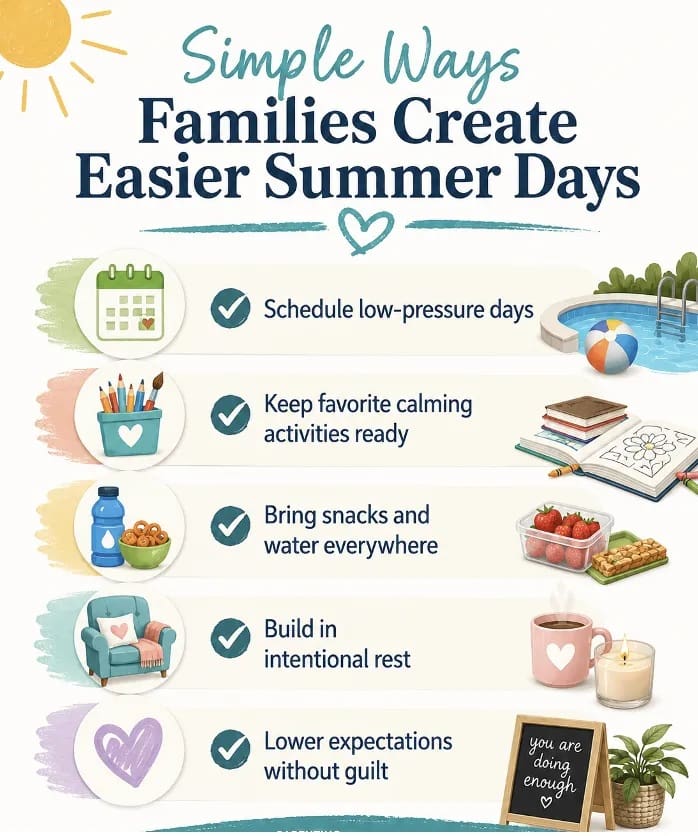
“Just like I schedule all of our appointments, I schedule days off to do nothing at home around our house. Of course, it never fails that someone is not feeling well or having a rough day, but those days are full of no-stress, low-pressure activities—watching movies, playing games, taking short walks, or even looking at old pictures and telling stories. For our family, planning trips or activities is so much more stressful than plans that let our bodies and minds rest.”
—Jamie, mother of 2 children with complex medical needs. She’s also an EMT and paramedic.
My Summer Strategies
My summer strategies continue to evolve as my kids grow. Early on, we gravitated to playgrounds, libraries, cafes, and parks. I found playgrounds that were completely fenced in and positioned myself so I could see my trio and the exit while I worked on my laptop.
Arlo’s been running off since the moment he could walk. To this day, I still need to keep an eye on my favorite escape artist. I adapted my wardrobe to be ready to run at all times. Extra clothes are always in the car for all of us, for accidents of all kinds, including the happy ones like finding a watering hole on a hike.
Transitions have always been tough. Leaving a playground, park, or pool was nearly impossible when my kids were younger. I always bring individual water bottles and a big one for refills. I fill a cooler bag with an abundance of healthy snacks. And I try to remember to throw in a can of iced coffee for myself.
Helpful Tools
When my kids were potty training and (finally!!) out of diapers, a travel potty was an absolute necessity. Specifically, the potette [1], which I cannot say enough good things about. It is compact, foldable, and uses absorbent bags, so you don’t have to clean a bulky mini-toilet on the go. I kept one in my car and another in the stroller for YEARS.

A must-have for any parent who’s working while caring for their child(ren): a hotspot on your phone with as much data as you can afford. This was a game-changer—allowing me to work on my laptop from virtually anywhere.
Now that my kids are older, I set up my office at our neighborhood pool in the summer. They swim while I find a quiet corner to join in on Zoom meetings.
Another tech recommendation for anyone needing an on-the-go office is a portable monitor [2]. Having a dual screen increases efficiency and is worth the investment for anyone who needs to access multiple pages at once.
Turning Appointments Into Vacations
I’ve also shifted out-of-town medical appointments to summer break whenever possible so they miss less school. Arlo sees 3 different groups of specialists in Boston, which is a 5-hour drive (longer if I go the speed limit, shhh). This year, I managed to schedule those visits within less than a week of each other.
So we get to plan a vacation in one of our favorite cities and might even squeeze in a trip to a nearby beach. Bonus: it saves money since these are a couple of trips we need to take anyway, condensed into one, with the main goal being fun.
Perhaps most important, as my fellow caregivers mentioned, is acceptance. Our lives are just different from those of our parenting peers who aren’t also caregivers. We cannot change our reality. But we can adjust our expectations, let go of what a stereotypical summer looks like, and build in time for rest and relaxation based on what works for our own family units.
About the Author
Erin Croyle is a journalist who has worked for National Geographic and Al Jazeera English. She was working in Malaysia when her first child, Arlo, was born in 2010. His diagnosis of Down syndrome transformed her career – shifting her focus to disability rights and advocacy. She’s currently the communications coordinator at Cornell University’s ACT for Youth [3], a communications specialist with the Center for Family Involvement [4] at VCU’s Partnership for People with Disabilities [5], and the creator and host of the podcast The Odyssey: Parenting. Caregiving. Disability [6].